 2025, Vol. 32


2. Electrical Engineering Department, I.K.Gujral Punjab Technical University Main Campus, Kapurthala 144603, Punjab, India
Normally, an electrical energy distribution system, comprising big and small consumers of electric power, is connected to high voltage systems through the transmission networks. In such networks, emerging Distributed Generation (DG) systems play a vital role in addressing various Power Quality (PQ) issues. It becomes paramount that the majority of PQ issues, namely, harmonic distortion, sag-swells, frequency variations, losses, and voltage profile, are suppressed by such DG systems. Until several years ago, the occurrence of temporary interruptions and distortions in the voltage waveform was of little importance to the customers of the distribution network. However, with the advent and advancements taking place in semiconductor technology, various renewable energy sources, such as Solar Photovoltaic (SPV), wind power, and battery-operated energy systems, are being coordinated successfully in developing economies.
Importantly, the validity of numerous PQ indicators is demonstrated through mathematical-statistical methods[1]. The effectiveness of the intercorrelation coefficient indicator is demonstrated for voltage and current signals for reliable operation of SPV and wind power stations. Equations for controlled parameters are as follows:
| $ \begin{gathered} I_{\text {ref }}=K_a\left(v_{\mathrm{dc}}+v_{\text {ref }}\right)+I_v \\ \frac{\mathrm{~d} I_v}{\mathrm{~d} t}=K_i\left(v_{\mathrm{dc}}-v_{\mathrm{ref}}\right) \end{gathered} $ |
where Ka is the proportionality gain term, Ki is the gain of the integral term, and vdc, vref are the reference terms[2]. For a conventional 3-Φ, 2-level DC-AC inverter, the level of Total Harmonic Distortion (THD) in voltage signal is 2.633. The estimated value of the performance ratio for the proposed system is found to be 71.2. An accurate simulation is performed for a three-phase model, with 500 ms simulation time. It is revealed that the unsymmetrical fault is mitigated at 126 ms in the current waveform. Alternatively, the harmonics are reduced through a proportional resonant controller at the Point of Common Coupling (PCC) for voltage and current signals in Ref.[3]. Especially, a promising case study on isolated microsystem Santa Maria del Loreto 1 is carried out for a residential system and analyzed. An integral proportional controller is implemented to decrease the stabilizing time and stationary error. According to the IEC 61000-2-2 standard (IEC-2002), it is reported that THD for voltage and current signals is 8.17% and 9.33%, respectively.
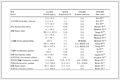
An adaptive neuro-fuzzy inference system is reported in Ref. [4] for multifunctional SPV grid-connected systems. Maximum Power Point Tracking (MPPT) control is implemented, which is capable of mitigating the oscillations caused by DC link voltage. Overall, the proposed system effectively controlls the power quality, maintaining the THD of the current waveform at 16.95%. A comparative analysis of THD is presented in Table 1.
|
Table 1 Comparative analysis in THD |
To objectively evaluate the performance of four anti-islanding shift strategies reported in Ref.[5], namely, active frequency, Sania frequency, Sandia voltage, and slip-mode, several PQ studies are elaborated through case studies in Ref.[3]. Importantly, their basic objective is to detect the islanding operation under various critical factors. Although Sandia frequency shift is analyzed for three cases by frequency gain acceleration: 0, 0.05 and 0.018 Hz-1 in Ref. [6], it has been examined that the circuit breaker opens after the completion of 6 cycles of the utility grid and is disconnected at t=0.5 s. Therefore, the effectiveness in detecting the islanding operation is highest through these anti-islanding shift strategies[7]. Furthermore, the voltage during the islanding operation majorly depends on the real power and resistance of the Insulated Gate Bipolar Transistor (IGBT) inverter, however, the change in frequency is observed by a change in the reactive power of the inverter[8].A detailed analysis of detection time, comparing voltage frequency and rate of change of frequency protection techniques, is presented in Table 2.
|
|
Table 2 Comparative analysis of four common methods for islanding detection[5] |
Furthermore, for a 12.25 kW SPV grid-connected system, a techno-economic analysis is presented in Ref. [11]. It is revealed that 87% of the required energy needs are catered by the system operating with a performance ratio and capacity factor of 0.78 and 0.22, respectively. More recently, the analysis of the application of super-capacitors is reported in Ref. [12]. It is proved that its application is capable of minimizing the magnitude of voltage fluctuations and is paramount with active power curtailment. A normal SPV system penetration of 40% is already caused by voltage transients, especially in the low-voltage grid. This analysis is concluded in Ref. [13]. All the aforementioned methods, although capable of operating under varying atmospheric conditions, however, fail to minimize the detecting time of islanding operation. Moreover, accountability for both voltage and frequency variations has not been acknowledged. Therefore, the present study majorly endeavours to highlight the efficient operation of the Anti-Islanding Protection (AIP) scheme consisting of Proportional Integral (PI)-controlled multi-vibrators scheme. It is revealed that the proposed scheme promptly operated its associated switchgear, and disconnected the utility grid from the DG systems, ultimately catering to the connected load demand.
Thus, the literature survey concludes that in majority of the research works, the islanding phenomenon is detected by passive methods by implementing techniques for tuning the impedance. Most of the power quality works are not validated by choosing any IEEE standard, especially under stochastic environmental conditions. Moreover, the present work does not require any additional equipment for changing the impedance in detecting islanding. In this work, detection of islanding is mainly performed by variation in active power, reactive power and voltage magnitude.
In this paper, an overview of a brief literature review is presented in the introduction. Then, a research methodology is discussed in Section 1. This is followed by a computational model developed in Matlab software in Section 2. The mathematical framework of the proposed anti-islanding scheme is presented in Section 3. A detailed view of this scheme is also discussed using the IEEE-1547 standard for validation under conditional constraints. Section 4 presents the Simulink results and its analysis. Finally, Section 5 reports the critical outcomes with the scope of the present research in the future.
1 Research MethodologyThe strategy for the implemented anti-islanding is presented in Fig. 1. The objective of the proposed AIP scheme is to envisage the study of the operation of utility-grid and connected loads under changing frequency and voltage variations. To mitigate such PQ issues, the scheme for a rate of change of frequency relay is implemented by differentiating it and comparing its estimated value with a reference value. Especially, the performance of the system is evaluated under the faulted conditions at the utility-grid side. Under such dynamic conditions, an anti-islanding scheme is operated at a three-leg IGBT-based inverter system.

|
Fig.1 Research methodology for islanding detection |
Major contributions of the proposed system are listed as follows:
1) An AIP scheme multivibrator operated system is developed, which is capable of controlling its frequency and voltage variations.
2) The proposed system is capable of operating in two modes: utility-grid and islanding modes.In utility-grid mode, reactive power compensation is achieved by controlling the voltage and frequency signals.
3) In islanding mode, it is unveiled that the real power requirement is obtained with reduced harmonics under the unsymmetrical fault conditions. An AIP scheme is implemented with reduced harmonics which has ably generated the controlled signals under the mismatch of real and reactive power with their pre-determined limits.
4) Since the switchgear scheme is consisting of circuit breakers operated by a PWM-controlled (Pulse Width Modulation) signal, the controlling strategy for the AIP scheme is implemented using multivibrators under two variable constraints and has reduced the detection time of islanding operation through the PI-based controllers.
5) Finally, the implemented AIP operation demonstrates no violation of the considered threshold limits under faulted conditions.
2 Computational ModelThe proposed Simulink model for detecting the anti-islanding condition is illustrated in Fig. 2. A hybrid model consisting of a Battery Energy Storage (BES) device in conjunction with an SPV array is connected to a DC bus. The maximum power capacity of the SPV array is 15 kW. Number of strings connected in parallel are 10, with 7 series connected modules per string. Under changing atmospheric conditions, the maximum real power capacity of each module is 400 W. The values of open-circuit voltage and short-circuit current are 220 V and 2.5 A, respectively. This data is taken from the validated manufacturer data sheet of the SPV module. Also, the voltage and current at MPP are 200 V and 2 A, respectively. In addition, a BES device consists of a lithium-ion battery of nominal voltage 230 V and a rated capacity of 100 Ah. Amongst its specifications, the cut-off voltage and full charge voltage is 172.5 and 267 V, respectively.

|
Fig.2 Block diagram of a SPV and BES utility-grid tied system |
To extract the maximum power from the SPV array, an Incremental Conductance (IC) type MPPT technique is implemented in the control circuitry. The simulink schematic is illustrated in Fig. 3. With the help of a six-pulse IGBT (Insulated Gate Bipolar Transistor) inverter circuit, the input DC power is converted into AC power. DC component is filtered from AC by using an Inductance-Capacitance-Inductance (LCL) filter circuit, and ultimately the AC power supply is fed into the utility grid system. An AIP scheme controlling technique is used for generating the false signal under islanding conditions. Table 3 illustrates the specifications for the developed system.

|
Fig.3 Simulink topology |
|
|
Table 3 Parameters for investigated system |
3 Analytic Implementation of Anti-Islanding Control
To estimate the optimum anti-islanding technique, there are two main constraints: Non-detection zone[14] and time detection[15]. An accurate and fastest time detection principle is proposed in Ref. [16], where an islanding condition is detected during under/over voltage, rate of change of frequency, current, and frequency[17] relays using Matlab implementation. It is pertinent to mention that all these relays are operated only one time during the simulation period.
Phase Locked Loop (PLL) algorithm is coordinated with the nominal value of voltage signals in a vector truth table. Thus, the output values of the under/over frequency relay are compared with the reference pre-determined values at the Point of Common Coupling (PCC). According to IEEE-1547 standard, Eq. (1) [9-10] is given as follows:
| $ 1-\left(\frac{f}{f_{\min }}\right)^2 \leqslant \frac{\Delta Q}{P} \leqslant 1-\left(\frac{f}{f_{\max }}\right)^2 $ | (1) |
where fmin and fmax are the threshold values of under/over frequency, respectively, f is the nominal values of voltage and frequency, respectively, (ΔP, ΔQ) are the nominal values of real and reactive power, respectively.
An accurate application of PLL is implemented in the rate of change of frequency relay by differentiating the frequency and comparing its value with reference pre-determined values at the point of coupling points. However, the threshold value is estimated using the IEEE-1547 standard and the relay is energized. It disconnects the SPV system from the utility grid. Moreover, the islanding phenomenon is achieved in Ref.[14] by matching the power generated by distributed generation resources with the power consumed by varying loads. Furthermore, 1-Φ and double-Φ faults are detected and mitigated by the speedy operation of circuit breakers and synchronization levels. Reference values of the IEEE-1547 standard are illustrated in Table 4.
|
|
Table 4 IEEE-1547 standard for anti-islanding |
Inverter output power is given by the following Eq.(2)[18]. The values of Pset and Qset are the reference values of active and reactive power under-normal conditions, respectively. Vo is the voltage across the capacitors connected for the removal of higher-order harmonics levels. The reference values of active and reactive powers are estimated from Eq.(2) and Eq.(3).
| $ P=P_{\text {set }}=\left(V_{\mathrm{o}}^2\right) / R_{\mathrm{T}} $ | (2) |
| $ Q=Q_{\text {set }}=V_{\mathrm{o}}^2\left(\frac{1}{2 \pi f_1 L_{\mathrm{T}_1}}-2 \pi f_1 C_{\mathrm{T}}\right) $ | (3) |
During islanding mode[18-20], there is a mismatch between the active and reactive power and also the voltage magnitude. The variation in all parameters is represented by Δ (ΔP, ΔQ, ΔV), as depicted in Fig. 4 (a). The mismatched values of active and reactive power under islanding mode are estimated by the following equations:
| $ \Delta P=P_{\text {set }}-P $ | (4) |
| $ \Delta Q=Q_{\text {set }}-Q $ | (5) |
| $ \Delta P=\frac{2 V_{\mathrm{o}}}{R_{\mathrm{T}}}-\frac{V_o^2}{R_{\mathrm{T}}^2} \Delta R_{\mathrm{T}} $ | (6) |
| $ \begin{aligned} \Delta Q= & \left.2 V_{\mathrm{o}}\left(\frac{1}{\left(2 \pi f L_{\mathrm{T}_1}\right.}\right)-2 \pi f_1 C_{\mathrm{T}}\right) \Delta V_{\mathrm{o}}-\frac{V_{\mathrm{o}}^2}{2 \pi f_1 L_{\mathrm{T}}^2} \Delta L_{\mathrm{T}}- \\ & 2 \pi f_1 V_{\mathrm{o}}^2 \Delta C_{\mathrm{T}}-V_{\mathrm{o}}^2\left(\frac{1}{2 \pi f_1^2 L_{\mathrm{T}}}+2 \pi C_{\mathrm{T}}\right) \Delta f \end{aligned} $ | (7) |

|
Fig.4 (a) Simulink strategy of anti-control (b) Block diagram of anti-islanding control |
where RT, LT, and CT are equivalent resistance, inductance, and capacitance at PCC respectively; ΔP and ΔQ are the power mismatch from grid-connected mode to islanding mode respectively; ΔRT, ΔLT, and ΔCT are variations in equivalent resistance, inductance, and capacitance from grid-connected mode to islanding mode, respectively.
From Eqs.(6) and (7), it is clear that the active and reactive power mismatch depends upon ΔRT, ΔLT and ΔCT. In case of no islanding, Pset and Qset equal to active and reactive power of inverter because RT=LT=CT=0. However, when islanding occurs, the parameters RT, LT, and CT show variations, resulting in a mismatch of active and reactive power.
Fig. 4 (b) displays the implemented scheme for alleviating the impact of islanding during the mismatched conditions[20-21]. As depicted, the controlling scheme has three OR gates. The output of the OR gate is high if any of its inputs are one (high). However, the IGBT-based inverters are synchronized to the utility grid after islanding, if the output of the OR gates is low. Thus, reset blocks are coordinated to generate a low output at the OR gates. In the implemented control, the output current of the IGBT-based inverter is used for estimating the real and reactive power. The controlling strategy for implementing the AIP scheme is implemented in such a way that it is ably operated effectively under two variable constraints:
Constraint 1: If the value of ΔQ becomes more than its limit of set threshold QL=0.1 p.u. during the delay time of 0.75 s, and active power and voltage magnitudes mismatch does not exceed their threshold limits, then the implemented AIP scheme will generate a new controlled signal for estimating Pset so that the new value of ΔP can be estimated.
Now, if the mismatch value of new real power exceeds its threshold value PL=0.1 p.u., the islanding condition is detected.
Constraint 2: If the value of ΔQ does not become more than its limit of set threshold QL=0.1 p.u. during the delay time of 0.75 s, whereas the value of active power mismatch exceeds their threshold limits PL, then the implemented AIP scheme will generate a new controlled signal for estimating Qset so that the new value of ΔQ can be estimated.
Now, if the mismatch value of new reactive power exceeds its threshold value, the islanding condition is detected.Both active and reactive power are sensitive to voltage and frequency, so ΔVo and Δf are set to zero, hence
| $ \Delta P=-\frac{V_{\mathrm{o}}^2}{R_{\mathrm{T}}^2} \Delta R_{\mathrm{T}} $ | (8) |
| $ \Delta Q=-\frac{V_{\mathrm{o}}^2}{2 \pi f_1 L_{\mathrm{T}}^2} \Delta L_{\mathrm{T}}-2 \pi f_1 V_{\mathrm{o}}^2 \Delta C_{\mathrm{T}} $ | (9) |
The mis-match in voltage is given by
| $ \Delta V=E_{\text {rated }}-V_{\mathrm{o}} $ | (10) |
Six signals are being generated through the output of the implemented AIP scheme which is directly being fed into the gate terminals of three-leg IGBT-based inverter systems. The six generated signals are the controlled signals. The simulink system, as depicted in Fig. 5, is being operated through two modes of operation: utility grid[22] and islanding[23]. In utility grid mode, the three phase generated signals Vabc and Iabc control the voltage and

|
Fig.5 Simulink model for AIP controlling scheme |
frequency of the utility grid for the reactive power compensation as given by Eqs. (3) and (9). Thus, the DG systems are capable of supplying the reactive power to the utility grid through the IGBT based systems by two reference signals: P and Q. However, in islanding mode, the real power requirements of the connected load are catered by the connected DG systems with reduced harmonics under the three-phase to-ground fault conditions[24]. It has been investigated that the implemented AIP controlling scheme is capable of detecting the islanding phenomenon in minimum time and controlling the PQ issues by generating distortion-less power.
4 Results Analysis and DiscussionThe capabilities of the developed system are investigated and analyzed by performing various simulation studies under transient conditions. In addition, the validation of the PQ study is established by investigating the performance of the AIP scheme as per IEEE-1547 standards. The time-domain simulations are performed on the proposed system characterized by specifications, especially chosen from validated manufacturer data sheets. Additionally, the proposed scheme is evaluated by introducing unsymmetrical faults at the utility grid side. It is pertinent to mention that the islanding condition is observed when there is a mismatch between active power, reactive power, and voltage magnitudes. Islanding condition is detected under aforementioned constraints. Notably, the condition of mismatch is observed under the two different scenarios:
Scenario 1: When Pload < Pgeneration;
Scenario 2: When Pload>Pgeneration.
where Pload is the power consumed by the local load and Pgeneration is the power generated by the SPV array and battery storage through the VSC (Voltage Source Converter) inverter.
Table 5 presents a PQ comparative analysis in summarized form for various controlling techniques and topologies of converter systems. Primarily, it is evident that the estimated value of THD is found to be less than 5%, according to the IEEE-1547 standard. The performance of a laboratory prototype is also tested by employing three protective relaying systems: under-voltage (Table 6), over-current (Table 7), and over-voltage relay (Table 8). The relaying system is implemented to mitigate the impact of islanding. The detection time to detect the anti-islanding phenomenon is computed and compared under the influence of various unsymmetrical faults. In addition, it is also computed and compared under Scenario 1 and Scenario 2. Finally, the efficacy of the system is demonstrated by carrying five time-domain case studies.
|
|
Table 5 Comparative analysis of THD for various controlling techniques |
|
|
Table 6 Detection time of under-voltage relay protection for anti-islanding[34] |
|
|
Table 7 Detection time for over-current protection of anti-islanding[27] |
|
|
Table 8 Detection time for over-voltage protection scheme of anti-islanding[27] |
1) Case Ⅰ presents the condition of no islanding under the no-load conditions. Waveform analysis is carried out at various PCCs at 60 Hz, and analysed.
2) Case Ⅱ evaluates the performance of the system at a 20 kW RLC linear load at the utility grid side.
3) Case Ⅲ detects the islanding condition during the presence of a three-phase to-ground fault. The efficacy
of PWM controlled PI controller is also demonstrated.
4) Case Ⅳ highlights that there is no violation of the considered threshold limits, till a specified time. Also, the islanding condition is detected under variation in frequency in this case study.
5) Case Ⅴ validates the outcomes according to the IEEE-1547 standard for validation. Waveform analysis of the AIP scheme is presented and discussed.
Overall, it is ensured that detection time to detect the condition of islanding is minimal with reduced frequency and voltage variations. The proposed switchgear scheme is efficiently operated by controlled signals from PWM-generated PI-based controllers. It is expected that the proposed controlling scheme consisting of multivibrators is logically operated and has minimized the detection time of islanding.
4.1 Case ⅠFig. 6 (a) depicts the distortion-less load voltage waveform under normal operating conditions. It can be seen that the maximum value of load voltage is maintained at 200 V. Fig. 6(b) depicts the sine nature of the three-phase utility grid current. It is maintained constant at 20 A from t=0 s to t=1.2 s. A small dip in utility-grid current is observed at t=1.2 s, which is due to the drop in frequency level from 60 Hz to 59.9 Hz, as shown in Fig. 6(c). However, from t=1.3 s to t=3.3 s, the maximum value of utility-grid current is maintained at 30 A. Notably from Fig. 6(d), the actual value of the real power closely tracks the reference value during this period and does not deviate significantly. This leads to the reactive power requirement of the local load, which is compensated through an IGBT-based three-phase inverter, as evident from Fig. 6(e).

|
Fig.6 Performance characteristics of utility-grid tied DG system |
As shown in Fig. 6(d) and (e), initially, the reference values of real and reactive power outputs of IGBT Pset and Qset respectively, feeding into load (indicated by a blue line) are set to zero. As compared, the actual values of Pset and Qset (indicated by the red line) begin to track the reference curve after t=1 s. It closely follows till t=5 s. It is evident that since associated Circuit Breaker(CB) is closed, no change is observed. Notably, the maximum value of real power is obtained as 15 kW. Consequently, Fig. 6(f) depicts that the Islanding Detection Signal (IDS) is zero under normal operating conditions. This is because the multivibrators responsible for generating the IDS signal are not activated under normal conditions. It is evident that ΔP, ΔQ, and ΔV are also zero under such conditions, and clearly, no islanding condition is observed in this case study.
4.2 Case ⅡIn this particular case, a series Resistance-Inductance-Capacitance (RLC) load having a real power capacity of 20 kW is connected at the utility grid side. Importantly, a linear load is connected through a circuit breaker at PCC to detect the condition of islanding. To justify this condition, the utility grid is disconnected at t=2.5 s by opening the contacts of the associated CB. Contacts of CB are closed at t=4 s.
Fig. 7(a) depicts the distortion-less load voltage waveform under normal operating conditions. It can be seen that the maximum value of load voltage is maintained at 200 V. Fig. 7(b) depicts the sine nature of the three-phase utility grid current. It depicts that the utility grid is consuming more power by drawing current with increasing load. However, the utility grid current is maintained constant at 20 A from t=1.25 s to t=2.5 s. Its maximum value is maintained at 10 A from t=2.5 s to t=4 s. It again attains its maximum value of 20 A from t=4 s to t=5 s. It is observed from Fig. 7(c) that constant frequency operation is maintained for the whole simulation time, except for a small undershoot at t=1.2 s. Fig. 7(d) displays the behavior of the actual value of real power consumed by local load maintained at 15 kW at t=1.5 s. The implemented IC-MPPT technique is thus capable of generating real power under varying stochastically environmental conditions.

|
Fig.7 Performance characteristics of utility-grid tied DG system with connected load |
The reactive power requirement of the load is compensated through IGBT-based three-phase inverter, as evident from Fig. 7 (e). Reactive power is maintained at 3 kVar from t=2 s to t=5 s. It is also evident from Fig. 7 (f) that IDS remains at zero level with connected load which indicates the islanding condition is not initiated in this case study.
4.3 Case ⅢTo investigate the performance during transient conditions, a three-phase to-ground fault is simulated at PCC at the local load side at t=2.5 s. This fault is cleared after 5 cycles at t=2.7 s. The objective of this case study is to detect the islanding condition during the presence of a three-phase to-ground fault.
Additionally, a series RLC load having a real power capacity of 20 kW is already connected at the utility grid side. Fig. 8 (a) displays the distortion-less load voltage waveform from t=0 s to t=2.5 s under normal operating conditions. Thereafter, the impact of fault is evident from t=2.5 s to t=2.7 s. The maximum level of voltage in each phase is maintained at around 40 V. During the faulted period, the utility-grid current shows abnormal behavior which is increased up to 400 A at t=2.4 s, as shown in Fig. 8 (b). However, as the fault is mitigated at t=2.7 s, the utility-grid current depicts a pure sine waveform. It is observed from Fig. 8(c) that constant frequency operation is maintained till t=2.5 s. There is a sudden rise in frequency up to 60.8 Hz during the presence of a fault. It regains its normal value of 60 Hz in the duration from t=2.7 s to t=5 s. Fig. 8(d) displays the abnormal behavior of the real power during the faulted period.

|
Fig.8 Performance characteristics of utility-grid tied DG system under faulted condition |
On similar patterns, Fig. 8 (e) displays the waveform of the reactive power requirement of the connected load during the faulted period. It is evident from Fig. 8 (f) that IDS remains at zero level with connected load. It indicates that the condition of islanding is not initiated during the faulted period. This is because the introduced three-phase to-ground fault is cleared at t=2.7 s by generating a controlled signal through the PI controllers. Thus, the PWM-based controlled signal is capable of mitigating the impact of the fault and maintaining normal conditions. It is also successfully able to reduce the real and reactive power flow mismatch at PCCs amongst utility-grid, connected load, and VSC-based converter systems.
4.4 Case ⅣIn this case study, it is pertinent to mention that there are three CBs connected: CB1 at the utility grid, CB2 at the IGBT inverter, and CB3 at the connected load. The switching time for CB2 is set from t=0.016 s to t=0.083 s. The switching time for CB3 is set from t=2.5 s to t=4 s. The switching time for CB1 is set from t=0 s to t=2.5 s. Now, the maximum value of real power consumed by the load is 15 kW.
In this case study, it is observed from Fig. 9 (a) that the islanding condition occurs at t=2.5 s. It is noted that there is no violation of the considered threshold limits till time t=2.5 s. However, the islanding condition is detected at t=3.25 s. The delay of 0.75 s has lapsed which is set and simulated by the AIP controlling scheme. Thus, when the IDS signal becomes unity, CB1 opens. This opening of CB1 disconnects the inverter from the utility grid, due to which the utility grid becomes zero at t=3.25 s, as shown in Fig. 9 (b). The inverter then operates in the isolation mode and supplies the SPV power to the locally connected load. It is also observed from Fig. 9 (c) that the level of frequency suddenly almost drops to 59.50 Hz at t=2.5 s, but it increases vertically and immediately after the drop and goes back to 59.60. It again attains 59.9 Hz from t=3.25 s to t=5 s. Fig. 9 (d) reveals that the real power supplied by the inverter to the local load is around 6 kW. Importantly, the reactive power absorbed by the local load is zero as evident from Fig. 9 (e). However, the voltage level remains at a constant level even during the islanding condition as described in Fig. 9 (a).

|
Fig.9 Waveforms during islanding condition; Scenario 1: (Pload < Pgeneration) |
4.5 Case Ⅴ
Case 5 is similar to Case 4, except for the variation in reactive power described in Fig. 10. The voltage remains at a constant level 200 V even during the islanding condition as described in Fig. 10 (a). But when the IDS signal becomes unity, CB1 opens. This opening of CB1 disconnects the inverter from the utility grid, due to which the utility grid becomes zero at t=3.25 s, as shown inFig. 10 (b). The value of grid current remains 10 A before islanding, but at t=2.5 s to t=3.25 s, the level of grid current increase up to 30 A. After that when IDS signal becomes unity, grid current becomes zero. As shown in Fig. 10(c), there is a vertical downward drop in frequency level, which increases dramatically afterwards and maintains the same level for some time from t=2.5 s to t=3.25.Finally, it increases and attains the value of 59.90 Hz. In the present scenario, simulation is carried out, though the power flow at the AC bus nearer to the load power, islanding is detected at t=фЕ3.25 s, фф because there will be a limit variation in the load reactive power (QL=0.1 p.u.), as shown in Fig. 10(e). In this case, we can detect the reactive power, it is necessary to show the protection for the entire design system using the AIP scheme, so when the IDS signal is 1 at t=3.25 s, CB1 is automatically tripped, which means it can isolate the main grid with micro-grid. Thus, the reactive power mismatch exceeds the threshold limit. In this special case, the threshold limit variation for real power flow is also set at 0.1 p.u. The islanding condition is detected only and only if the new real power mismatch exceeds its threshold limit. Notably, the proposed logic circuit, consisting of multivibrators, generates the IDS signal at t=3.25 s. This action opens the CB1 and isolates the grid which makes the grid current zero. At t=3.25 s, the active power mismatch also exceeds the threshold value, as shown in Fig. 10 (d). At this time, AIP generates a command signal to change Pset. Finally, the inverter operates in stand-alone mode and feeds the real power into the locally connected load.

|
Fig.10 Implementation of anti-islanding control: Scenario 2(Pload>Pgeneration) |
The AIP controlling scheme generates an IDS signal when there is a mismatch in active and reactive power. However, when inverter is connected to grid then no mismatch in active and reactive power, no islanding signal is generated. In this study, the islanding condition occurs in two cases: First, when the local load is less than the power supplied by inverter. In the second case, it occurs when the local load is equal to power send by inverter. It is revealed that in both cases, there is a mismatch in active and reactive power. In first case, the reactive power exceeds the threshold value (0.1 p.u.), and in second case, active power and voltage magnitude exceed the threshold values (0.1 p.u.). Here, the islanding occurs at t=2.5 s, whereas the IDS signal generates at t=3.25 s i.e. after t=0.75 s, which is the detection time, as shown in Fig. 10 (f).
Figs. 11 (a) and (b) illustrate the THD analysis of grid and inverter output voltage, respectively. THD is 0.26% for grid voltage. It validates according to the IEEE-1547 standard which stipulates that the THD of grid voltage must be less than 5%. In addition, the THD of inverter output voltage is 40.33%, just before the application of passive filters. It is revealed in Ref.[35] that oscillations are mitigated with reference current generator control strategy under dynamic conditions of utility-grid. This strategy is found to demonstrate faster transient response with zero steady-state errors and reduced harmonics. In Ref.[36], Lypaunov based harmonic restraint has been proposed for electric vehicle interfaced utility-grid which exhibits the capability of reducing THD, and extraction of more accurate signals.

|
Fig.11 THD for grid voltage and inverter output voltage |
5 Conclusions
This work investigated the performance of the AIP scheme under the influence of frequency and voltage variations. The proposed islanding scheme has closely recognized the islanding condition by continuously monitoring the mismatch of real, reactive power, and voltage magnitude. To achieve this, a PI-controlled PWM switching signal has efficiently operated the set of multivibrators. It is found that the proposed scheme has ably demonstrated its effectiveness by extracting maximum real power from a hybrid DG system connected at its input. Further, the simulation results show that the reactive power requirements of the connected load are met by the DG system through an IGBT-based inverter. It is also revealed that the AIP scheme is capable of detecting the islanding operation in minimum detection time, and isolates the utility-grid system through an efficient control in both modes: utility-grid and islanding modes. Furthermore, the IC-MPPT technique has ensured the extraction of maximum power at reduced harmonics. Major findings of this research work are presented below.
1) In the present work, a multivibrator-based AIP scheme is implemented on a utility grid integrated with Battery Energy Storage Device (BESS), with variations in active power, reactive power and voltage magnitude.
2) An IDS signal is generated when islanding occurs. The detection of islanding is mainly due to a mismatch of reactive power, active power and voltage magnitude.
3) The proposed scheme is also capable of eliminating power quality issues.
The main objective of the AIP scheme is that there must be no violation of the considered is threshold limits even under the faulted condition, upto the specified time. The target of the simulations is achieved and proved. Finally, a harmonic study is validated by the IEEE-1547 standard for validation through various case studies. Overall, accurate and satisfactory results from the waveforms are obtained. The practising engineers in energy industry may apply this proposed model by developing a small prototype model for addressing specific power quality issues and concerns.
| [1] |
Kulikov A L, Shepovalova O V, Ilyushin P V, et al. Control of electric power quality indicators in distribution networks comprising a high share of solar photovoltaic and wind power stations. Energy Reports, 2022, 8(suppl. 9): 1501-1514. (  0) 0) |
| [2] |
Jeelani S H, Puviarasi R, Chilambarasan M, et al. An approach to the utilization of grid integration to analyze the performance and quality of solar photovoltaic model. Energy Reports, 2022, 8(suppl.8): 1029-1044. DOI:10.11916/j.issn.1005-9113.2015.04.006 ( 0) |
| [3] |
Grau F, Vazquez L, Cervantes J, et al. Solar microsystem modelling and simulation: photovoltaic inverter control based on energy technical product quality criteria. IFAC-PapersOnline, 2022, 55(9): 87-92. DOI:10.1007/s10999-020-09497-8 ( 0) |
| [4] |
Soumana R A, Saulo M J, Muriithi C M. New control strategy for multifunctional grid-connected photovoltaic systems. Results in Engineering, 2022, 14: 100422. DOI:10.1016/j.ymssp.2021.107833 ( 0) |
| [5] |
Barkat F, Cheknane A, Guerrero J M, et al. Review, analysis, and performance evaluation of the most common four active methods for islanding detection in grid-connected photovoltaic systems. Electric Power Systems Research, 2023, 214(part A): 108909. DOI:10.1016/j.compstruct.2020.112910 ( 0) |
| [6] |
Laghari J A, Mokhlis H, Karimi M, et al. Computational intelligence based techniques for islanding detection of distributed generation in distribution network: A review. Energy Conversion and Management, 2014, 88: 139-152. DOI:10.1002/pts.2795 ( 0) |
| [7] |
Lopes L A C, Sun H L. Performance assessment of active frequency drifting islanding detection methods. IEEE Transactions on Energy Conversion, 2006, 21(1): 171-180. DOI:10.1007/s10483-022-2917-7 ( 0) |
| [8] |
Barkat F, Cheknane A. ssessment of non-detection zone of different active anti-islanding methods for single and multi-inverters grid connected photovoltaic power systems. Journal of Sciences and Engineering Sciences, 2019, 8(1): 34-43. DOI:10.1080/13588265.2022.2101306 ( 0) |
| [9] |
Ye Z, Kolwalkar A, Zhang Y, et al. Evaluation of anti-islanding schemes based on nondetection zone concept. IEEE Transactions on Power Electronics, 2004, 19(5): 1171-1176. DOI:10.1016/j.tws.2020.107337 ( 0) |
| [10] |
Estедbanez E J, Moreno V M, Pigazo A, et al. An overview of anti-islanding detection algorithms in photovoltaic systems in case of multiple current-controlled inverters. 35th Annual Conference of IEEE Industrial Electronics. Piscataway: IEEE, 2009: 4555-4560. DOI:10.1016/j.tws.2022.110313
( 0) |
| [11] |
Imam A A, Al-Turki Y A, Sreerama Kumar R. Techno-economic feasibility assessment of grid-connected PV systems for residential buildings in Saudi Arabia-A case study. Sustainability, 2020, 12(1): 262. DOI:10.1016/S0045-7949(01)00089-X ( 0) |
| [12] |
Vissar L R, Schuurmans E M B, AlSkaif T A, et al. Regulation strategies for mitigating voltage fluctuations induced by photovoltaic solar systems in an urban low voltage grid. International Journal of Electric Power & Energy Systems, 2022, 137: 107695. DOI:10.12989/sem.2008.28.5.495 ( 0) |
| [13] |
Wong J, Lim Y S, Tang J H, et al. Grid connected photovoltaic system in Malaysia: A review on voltage issues. Renewable and Sustainable Energy Reviews, 2014, 29: 535-545. DOI:10.1016/j.ijmecsci.2015.12.006 ( 0) |
| [14] |
Elshrief Y A, Abd-Elhaleem S, Asham A D, et al. AI protection algorithms for PV-Grid connection system. International Conference on Innovative Trends in Communication and Computer Engineering (ITCE). Piscataway: IEEE, 2020, 341-345. DOI:10.1016/j.ijmecsci.2018.06.001 ( 0) |
| [15] |
Ye Z, Kolwalkar A, Zhang Y, et al. Evaluation of anti-islanding schemes based on non-detection zone concept. IEEE Transactions on Power Electronics, 2004, 19(5): 1171-1176. DOI:10.1177/1099636218813196 ( 0) |
| [16] |
Elshrief Y A, Helmi D H, Elhaleem S A, et al. Fast and accurate islanding detection technique for microgrid connected to photovoltaic system. Journal of Radiation Research and Applied Sciences, 2021, 14(1): 210-221. DOI:10.1080/15376494.2018.1488311 ( 0) |
| [17] |
Hashemi F, Mohammadi M, Kargarian A. Islanding detection method for microgrid based on extracted features from differential transient rate of change of frequency. IET Generation, Transmission & Distribution, 2017, 11(4): 891-904. DOI:10.1177/10996362211020457 ( 0) |
| [18] |
Amin M, Zhong Q C, Lyu Z. An anti-islanding protection for VSM inverter in distributed generation. IEEE Open Journal of Power Electronics, 2020, 1: 372-382. DOI:10.1002/pts.2494 ( 0) |
| [19] |
Bekhradian R, Pasand M S. A comprehensive survey on islanding detection methods of synchronous generator based microgrid: Issues, solution and future works. IEEE Access, 2022, 10: 76202-76219. DOI:10.1088/2053-1591/acc2a4 ( 0) |
| [20] |
Marchesan G, Maresch K, Cardoso G. Distributed synchronous generation ride-through enhancement by anti-islanding protection blocking. Electrical Power Systems Research, 2021, 196: 107232. DOI:10.17341/gazimmfd.1287380 ( 0) |
| [21] |
Zamani R, Moghaddam M P, Panahi H, et al. Fast islanding detection of nested grids including multiple resources based on phase criterion. IEEE Transactions on Smart Grid, 2021, 12(6): 4962-4970. DOI:10.1177/0021998308099225 ( 0) |
| [22] |
Talha M, Raihan S R S, Rahim N A. A grid-tied PV inverter with sag-severity-independent low-voltage ride through reactive power support and islanding protection. Journal of Modern Power Systems and Clean Energy, 2021, 9(6): 1300-1311. DOI:10.1016/S0894-9166(16)30267-1 ( 0) |
| [23] |
Bakhshi-Jafarabadi R, Ghazi R, Sadeh J. Power quality assessment of voltage positive feedback based islanding detection algorithm. Journal of Modern Power Systems Clean Energy, 2020, 8(4): 787-795. DOI:10.1016/j.ijmecsci.2020.105451 ( 0) |
| [24] |
Seyedi M, Taher S A, Ganji B, et al. A hybrid islanding detection method based on the rates of changes in voltage and active power for the multi-inverter systems. IEEE Transactions on Smart Grid, 2021, 12(4): 2800-2811. DOI:10.1016/j.compstruct.2020.113396 ( 0) |
| [25] |
Kangante V, Vijayaganesh R. An improved SRF-theory based controller applied to three phase grid interfaced PV system for power quality improvement and islanding detection. 2018 IEEE Innovative Smart Grid Technologies-Asia (ISGT Asia). Piscataway: IEEE, 2018: 740-745. DOI:10.1016/j.matdes.2008.08.044
( 0) |
| [26] |
Aly M, Ramadan H M. Design and implementation of adaptive SVPWM algorithm for multilevel inverters in renewable energy applications. Solar Energy, 2019, 183: 745-754. DOI:10.3390/ma14133630 ( 0) |
| [27] |
Chishti F, Murshid S, Singh B. LMMN based adaptive control for power quality improvement of grid intertie wind-PV system. IEEE Transactions on Industrial Informatics, 2019, 15(9): 1-11. DOI:10.1016/j.compstruct.2018.06.114 ( 0) |
| [28] |
Mohamed S R, Jeyanthy P A, Devaraj D. Hysteresis-based voltage and current control techniques for grid connected solar photovoltaic systems comparative study. International Journal of Electrical and Computer Engineering, 2018, 8(5): 2671-2681. DOI:10.1007/BF01183678 ( 0) |
| [29] |
Goetz S M, Wanga C, Li Z, et al. Concept of a distributed photovoltaic multilevel inverter with cascaded double H-bridge topology. Electrical Power and Energy Systems, 2019, 110: 667-678. DOI:10.1007/BF01177451 ( 0) |
| [30] |
Elmelegia A, Aly M, Ahmedd E M, et al. A simplified phase-shift PWM-based feed-forward distributed MPPT method for grid-connected cascaded PV inverters. Solar Energy, 2019, 187: 1-12. DOI:10.1177/0731684415580329 ( 0) |
| [31] |
Golzaria S, Rashidia F, Farahani H F. A Lyapunov function based model predictive control for three phase grid connected photovoltaic converters. Solar Energy, 2019, 181: 222-233. DOI:10.1016/j.ijmecsci.2021.106475 ( 0) |
| [32] |
Marwan S A, Yousif D, Ali H N. Power quality improvement of grid-connected photovoltaic system using PI-fuzzy controller. International Journal of Applied Power Engineering, 2022, 11(2): 120-133. DOI:10.1007/s12206-021-1001-6 ( 0) |
| [33] |
Singh H, Gupta S, Gupta A. Implementation of an anti-windup control under partial shading for a photovoltaic grid interfaced system. Proc. IOP Conference Series: Earth and Environmental Science, 2023, 1110(1): 012082. DOI:10.1016/j.ijimpeng.2010.10.004 ( 0) |
| [34] |
Ioan V B, Marcel I, Dragos M, et al. A study on anti-islanding detection algorithm for grid tied photovoltaic system. International Conference on Optimization of Electrical and Electronics Equipment (OPTIM). Piscataway: IEEE, 2014: 655-660. DOI:10.1017/CBO9781139878326
( 0) |
| [35] |
Çselik D, Meral M E. Current control based power management strategy for distributed power generation system. Control Engineering Practice, 2019, 82: 72-85. DOI:10.1016/S0022-5096(97)00082-3 ( 0) |
| [36] |
Çselik D. Lyapunov based harmonic compensation and charging with three phase shunt activepower filter in electric vehicle application. International Journal of Electrical Power and Energy Systems, 2022, 136: 107564. DOI:10.1007/BF01190010 ( 0) |